
In modern SEO, ranking is no longer about publishing more content—it’s about publishing smarter content. One of the most powerful strategies for that is content gap analysis, a method that reveals what your competitors are ranking for that you are not.
If you know what they’re missing, you know exactly where your opportunity lies.
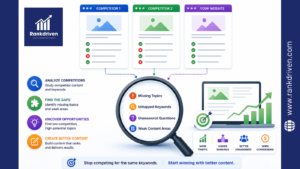
What is Content Gap Analysis?
Content gap analysis is the process of identifying keywords, topics, and subtopics that your competitors are ranking for—but your website is not.
It helps you answer three critical questions:
- What topics are driving traffic to competitors?
- What questions are users searching that I haven’t covered?
- Where are the untapped SEO opportunities in my niche?
Think of it as finding “hidden profit zones” in your content strategy.
Why Content Gap Analysis Matters
Most websites fail not because they lack content, but because they lack strategic content coverage.
Here’s what you gain:
1. Faster SEO Growth
Instead of guessing what to write, you target proven keywords already driving traffic.
2. Higher ROI Content Creation
You stop wasting time on low-impact topics and focus on what actually brings users.
3. Competitive Advantage
You discover blind spots in your competitors’ strategies and fill them before they do.
4. Better Topical Authority
Covering full topic clusters improves your authority in Google’s eyes.
How to Do Content Gap Analysis (Step-by-Step)
Step 1: Identify Your Competitors
Start by listing 3–10 real competitors. These should be:
- Websites ranking for your target keywords
- Not necessarily your business competitors
- Blogs dominating your niche
Use Google search for your main keyword and note who appears repeatedly.
Step 2: Extract Competitor Keywords
Use SEO tools like:
Enter competitor domains and extract:
- Top ranking pages
- Organic keywords
- Traffic-driving pages
This gives you a full map of what they’re ranking for.
Step 3: Find Missing Keywords
Now compare:
- Your keyword list
- Competitor keyword list
You are looking for:
- Keywords they rank for, you don’t
- Topics they cover, you haven’t
- Questions they answer, you ignore
These are your content gaps.
Step 4: Group Keywords into Topics
Don’t treat keywords individually. Group them into topic clusters like:
- “SEO strategy for beginners”
- “local SEO ranking factors”
- “technical SEO checklist”
This helps you build pillar pages + supporting blogs.
Step 5: Prioritize High-Value Gaps
Not all gaps are equal. Focus on:
- High search volume keywords
- Low to medium competition
- Buyer intent topics
- Evergreen content
This is where ROI becomes strong.
Step 6: Create Better Content Than Competitors
Do not copy—upgrade.
Your content should:
- Be more structured
- Answer more sub-questions
- Include updated data
- Provide actionable steps
- Improve readability
Google rewards depth + usefulness.
Common Types of Content Gaps
1. Keyword Gaps
Keywords competitors rank for but you don’t.
2. Topic Gaps
Entire subjects missing from your website.
3. Format Gaps
Competitors use videos, guides, or tools—you don’t.
4. Intent Gaps
They answer informational intent, but you miss transactional or commercial intent.
Best Tools for Content Gap Analysis
Here are some powerful tools used by SEO professionals:
- Google Search Console – Find keywords you already appear for but don’t rank well
- Semrush – Full competitor keyword and gap analysis
- Ahrefs – Deep backlink + keyword gap tracking
- Ubersuggest – Budget-friendly keyword discovery tool
Real Example (Simple Breakdown)
Imagine your site is about “digital marketing”.
Competitor ranks for:
- SEO for beginners
- Local SEO checklist
- Content marketing strategy
- Email marketing funnels
But your site only covers SEO basics.
That means your content gap includes:
- Local SEO
- Email marketing
- Content strategy
These become your next content opportunities.
Final Thoughts
Content gap analysis is not just an SEO tactic—it’s a growth system.
Instead of guessing what to write, you:
- Study competitors
- Extract proven topics
- Fill missing areas
- Build authority faster
The websites that win in 2026 are not the ones who publish the most—but the ones who cover what others ignore.